Latest in Your Instrumentation

Find your career in Instrumentation # We are not responsible for any error/ mistakes in the contents of this blog # Please send us the updates/ Articles/ Conference lists to us for a free publication in this blog >> # Welcome to "Your Instrumentation" # Contact me through yourinstrumentation@gmail.com # Find out your successful career in Instrumentation

Saturday, May 5, 2018

NBA Accredited Engineering Colleges in Kerala | 2018 Latest

The National Board of Accreditation (NBA), India was initially established by AICTE (All India Council of Technical Education) under section 10(u) of AICTE act, in the year 1994, for periodic evaluations of technical institutions & programs basis according to specified norms and standards as recommended by AICTE council.
NBA in its present form came into existence as an autonomous body with effect from 7th January 2010, with the objective of Assurance of Quality and Relevance of Education, especially of the programs in professional and technical disciplines, i.e., Engineering and Technology, Management, Architecture, Pharmacy and Hospitality, through the mechanism of accreditation of programs offered by technical institutions.
NBA has introduced a new process, parameters and criteria for accreditation. These are in line with the best international practices and oriented to assess the outcomes of the programme
Here are the NBA Accredited institute in Kerala. Currently 15 institutes have NBA accreditation in Kerala.

NBA | NBA for Kuwait Jobs | Institutes in Kerala | NBA colleges | Best institutes in Kerala | Best Engineering Colleges in Kerala

BSR Ranking of Self financing Engineering Colleges in Kerala

A private agency ranking found in recent watsapp forwards.
You can consider this for reference.
.

Friday, March 16, 2018

Turbine flow meter | Flow measurement


•Turbine flowmeters use the mechanical energy of the fluid to rotate a “pinwheel” (rotor) in the flow stream. Blades on the rotor are angled to transform energy from the flow stream into rotational energy. The rotor shaft spins on bearings.
•When the fluid moves faster, the rotor spins proportionally faster. Turbine flowmeters now constitute 7% of the world market.
•Operation in limited range of temperature (upto 60 deg C). High temperature may damage the flow meter.

Sunday, March 4, 2018

Piping & Instrumentation Diagram

Process flow diagrams (PFDs) are used in chemical and process engineering. These diagrams show the flow of chemicals and the equipment involved in the process. Generally, a Process Flow Diagram shows only the major equipment and doesn't show details. PFDs are used for visitor information and new employee training.
A Process and Instrument Drawing (P&ID) includes more details than a PFD. It includes major and minor flows, control loops and instrumentation. P&ID is sometimes referred to as a Piping and Instrumentation Drawing. These diagrams are also called flowsheets. P&IDs are used by process technicians and instrument and electrical, mechanical, safety, and engineering personnel.
Piping and instrumentation diagram (P&ID): A diagram which shows the interconnection of process equipment and the instrumentation used to control the process.
In both diagrams arrows show the flow of material and symbols show tanks, valves, and other equipment. The symbols used vary somewhat from organization to organization. So you may see several different symbols that all represent a motor.

P&ID symbols is  provided below:


Saturday, March 3, 2018

The future Era: Artificial Intelligence, Robots and Automation


Technological advancements and digital transformations are drastically changing the way we do business today. Technologies like Big Data, Internet of Things (IoT), Artificial Intelligence/ Machine Learning, Robots and Automation are the new buzzwords of today, transforming user experience, engaging the consumer, analyzing patterns and enabling proactive and real-time response.
           Intelligence and automation combined can change the way business is done across all sectors of the economy. Intelligent automation systems sense and synthesize vast amounts of information can automate entire processes or workflows, learning and adapting as they go and give consumers an experience that is highly customized to their tastes and preferences. Artificial Intelligence (AI) takes personalization to the next level as AI, in the form of Machine Learning (ML), can predict and personalize answers to customers’ queries and requests. This trend enables marketers to have one-on-one customers’ conversations by applying data points from social media posts, browsing and purchasing histories, and past customer interactions to get a complete view of every customer. Ray Kurzweil, the famous American author, computer scientist, inventor, and futurist said that Artificial intelligence will reach human levels by around 2029. Machines are becoming more intelligent and capable each day in performing tasks that need narrow as well as broad intelligence.
Traditionally machines were envisaged to automate tasks that involved a great deal of repetition or standardized, hazardous tasks with great quality and less management overheads to deliver better outcomes. Machines today can manage information, connect with vast data sources, analyze and pull out the right information/ insights with minimum human intervention. Software can learn and intelligently interpolate and extrapolate data. More importantly, it can learn and adapt.
            A report released by Business Insider states that by the year 2020, about 34 billion devices will be connected to the internet with apps and software that will collect data from customers like geo location, search history, browsing habits etc. but all in un-intrusive ways, thus, eliminating the burden of data capture that creates privacy concerns. Big industry players like Google, Apple, Facebook, Microsoft, Amazon, IBM, etc., are paving the way by embracing advanced technologies like AI, ML as well as their Digital Assistants such as Siri, Cortana, Alexa, etc. With the involvement of intelligent systems like robots in the workplace, businesses will soon witness a multi-faceted shift. Manual warehouse has always demands a massive investment in workforce, the most of the warehouse labor cost gets exhausted in ‘Picking’. Here, the automation comes into the game. The new warehouse operation advancements are linked to an integration of software solutions that drive the use of inventory optimization tools, and robotics. Amazon recently launched the first ‘self-driving’ grocery store, Amazon Go with no checkout lines, in Seattle in early 2017.  
               Walmart, is experimenting with robot shopping carts. Walmart also said it was testing whether drones could help check the inventory in its stores. And Elon Musk is teaching robots new tricks through Virtual Reality lessons! Workforce will take over 30 percent of jobs by 2025. Consequently, some jobs will be lost, while some new jobs will be created. Kev Cooke, Managing Editor D/SRUPTION said that Successful new technology often develops, displaces, disrupts or destroys a previous technology or mode of being, but with each new technology, the horizon of possibility retreats further, offering us new opportunities, new collaborations, recombinations of old ideas and new ways of being and working. Artificial Intelligence, Robots and Automation will offer new opportunities for human endeavour and new markets will follow.
-          Dr. Godwin Anand P S


*The author is an expert in the area of Automation. He is currently associated with Saintgits College of Engineering, Kottayam as Professor & HoD of Interdisciplinary Engineering. He is currently an approved PhD guide in Kerala Technological University.

Profile: http://saintgits.org/engineering-college/department/faculty-list?faculty_id=238

#Article on Automation #Saintgits College of Engineering #Robotics #Artificial Intelligence

Friday, March 2, 2018

B. Tech- Instrumentation in National Institute of Technology's (NIT's)

B. Tech- Instrumentation in National Institute of Technology's (NIT's)


The following NIT's have Bachelors course in Instrumentation either in form of Electronics & Instrumentation or as Instrumentation and Control.

1. NIT Trichy      (https://www.nitt.edu/)
2. NIT Silchar     (http://www.nits.ac.in/)
3. NIT Agartala  (http://www.nita.ac.in/)
4. NIT Jalandhar (http://www.nitj.ac.in/)
5. NIT Nagaland (https://nitnagaland.ac.in/)

Instrumentation in Nagaland started in the year 2016-17. All NIT's having well equipped laboratories and efficient labs under the department of Instrumentation.

#Instrumentation in NIT's #Instrumentation B.Tech 

Wednesday, February 28, 2018

Viva questions for Measurements Lab

1.      Mention some of the transducers.
2.      State the advantages of LVDT.
3.      Define transducer?
4.      What is the pressure transducer?
5.      What are the advantages of bridges?
6.      What is meant by balanced condition for Wheatstone bridge?
7.      Are RTDs and thermocouples intrinsically safe?
8.      What are the major differences between a thermocouple and an RTD?
9.      What are the major advantages of a thermocouple ?
10.  What are the major advantages of RTD?
11.  Write law of Intermediate material for Thermocouple
12.  What are the major disadvantages of a thermocouple ?
13.  What are the major disadvantages of RTD ?
14.  What is the working principle of mercury in glass thermometer?
15.  What is a thermocouple & how does it work?
16.  What is the working principle of a thermocouple?
17.  What is a RTD?
18.  How does Maxwells bridge works?
19.  For which parameter measurement, Scherings bridge used?
20.   What is a Hays Bridge?

Tuesday, December 19, 2017

Srishti 2018 | National Level Project Competition | India

Srishti 2018 | Saintgits | Project Competition | Technical Proects | Engineering Projects | B. Tech Projects | Innovative Project Ideas | Free entry | Online Registration

Wednesday, July 16, 2014

Wednesday, July 2, 2014

TK3 Calibration Instrument


The TK3 Calibration instrument simulates shaft vibration and position for calibrating Bently Nevada monitors. It verifies the operating condition of the monitor readouts as well as the condition of the proximity transducer system. A properly calibrated system means that the monitor readings and transducer inputs are accurate. A spindle micrometer is used to check the transducer system and position monitor calibration. A probe mounting adapter provided with the TK3 holds the probe while the targt is moved toward or away from the probe tip in calibrated increments. The output from the proximitor sensor is recorded using a voltmeter.
Vibration monitors are calibrated using the motor-driven wobble plate to hold the proximity probe in place. The holder is located over the wobble plate to hold the proximity probe in place. The holder and probe are adjusted to a position where the desired amount of mechanical vibration is found. The vibration is then measured using a dial micrometer that is supplied with the unit (no oscilloscope is needed).
A vibration monitor's reading can then be compared to the known mechanical vibration signal input. The mechanical vibration signal from the TK3 can range from 50 to 254 micro meter (2 to 10 mils) peak-to-peak.

Tuesday, July 1, 2014

The Roboversity Summer Training and Internship Program

The Roboversity Summer Training and Internship Program

              
Workshop Details
The Roboversity Summer Training cum Internship Program is a fast paced internship and training program for robotics enthusiasts to explore and learn the vast field of robotics at a lightning pace! This is the program where learning happens not by listening, but by doing! Each participant will develop 7 different robots using combinations of various technologies in a span of 15 days. The program is going to be fast, exhaustive, challenging and fun at the same time.

Workshop Specialities:

  • Understand, design and develop 7 robots yourself under the guidance of our faculty
    • Basic
      • Line Follower Robot
      • Obstacle Avoider Robot
      • Obstace Follower Robot
      • Phototropic Robot
      • Photophobic Robot
    • Medium
      • Mobile Robotics
      • Maze Solver Robot
    • Advanced
      • Swarm Robotics
      • Gesture Based Robot
  • The workshop is desgined and developed by IIT Kanpur Engineering Graduates
  • Certification from Roboversity and MobMe Wireless (for Mobile Robot)

Outcomes:

Highlights of Program:

  • Learn to Design and Build 7 different kinds of robots involving concepts from Sensor Based Autonomous Robotics, Mobile Operated Robots, Swarm Robotics and Gesture Based Robotics
  • Courses designed by graduates of IIT Kanpur
  • Well-structured program that spans from basics to advanced robotics
  • Develop live working Robotics Projects
  • Complete Kit and software resources provided to participants
  • Encourages participants to think and come up with new designs
  • Online Examination and certificate with score

Certification:

  • Industry certificate from MobMe Wireless
  • Certificate of Participation to all the participants
    • With Online Examination Scores for those who qualify
    • Without Online Examination Scores for those who donot qualify
  • Certificate of Merit by Roboversity and MobMe Wireless to the top-performers
    • The names of the winners will be put up on our participant-awards page permanently

Awards:

The following awards will be given to top-performing participants
  • Best Project Award
  • Best Fabrication Award
  • Fastest Fabrication Award
  • Innovation Award

Workshop Course Content:

  • Understanding the application of various sensors and integration with Microcontrollers
  • Exposure to Mobile Communication
  • Understanding of Accelerometer sensors
  • Introduction to Swarm Intelligence and its implementation in Robotics
  • Understanding the structure and programming of Microcontrollers
  • Live testing and competition of robots

Topics to be covered:

  • Basics of Robotics
  • Embedded Systems and embedded C programming
  • Sensor Guided Autonomous Robotics - using various sensors
  • Mobile operated Robotics - using DTMF module
  • Gesture Based Robotics - using Accelerometer
  • Swarm Robotics - using RF module

Kit Details:

The following kit would be given to the participants

Hardware:

  • Skyfi Labs' Robotics Development Board
  • Microcontroller
  • All ICs and IC Holders
  • DC Motors
  • Wheels
  • IR Sensors
  • DTMF decoder module
  • Audio jack
  • Accelerometer Sensors
  • RF Tx-Rx Module
  • Programming Cable
  • 12 V Battery
  • Chassis
  • Digital Multi Meter*
  • Working Tools*
  • Other miscellaneous items


OtherMaterial:

* will be taken back after the workshop

Booklets on

  • ICs and Microcontroller
  • Skyfi Labs' robotics development board
  • All the sensors and components used in the workshop
  • Programming and burning software
  • Maintenance of robots

Who should attend?

  • Student from any background with interest in robotics

Contact Details

Please feel free to contact us in case of any queries. 
Email: info@roboversity.com
Phone: Office: 080-41120662, 080-28531277, Support Team: +91-8050055611 
http://summertraining.roboversity.com/

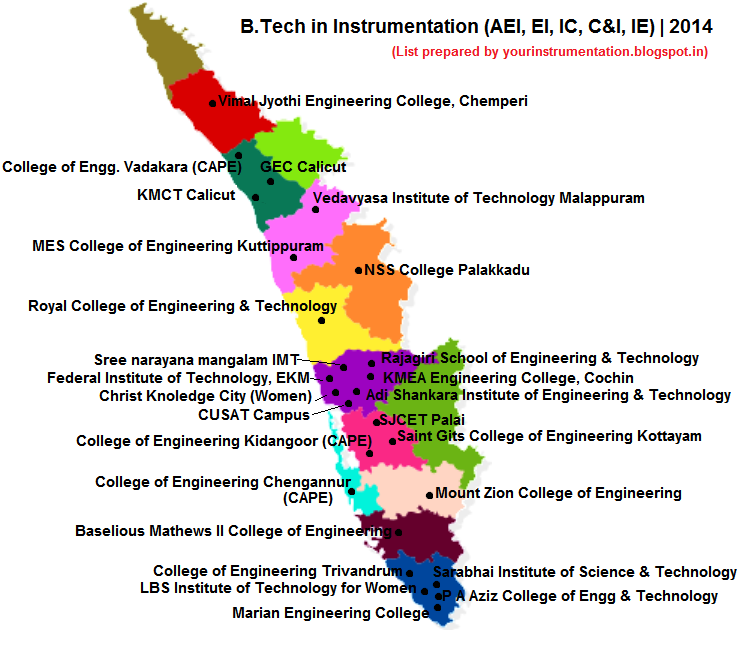
B. Tech In Instrumentation (AEI, EI, IC, C&I, IE) | Updated List 2014


National Symposium on Instrumentation (NSI-39) by Instrument Society of India (ISOI)

Venue: Gurukul Kangri University, Haridwar-249402.
Last date for submission of abstracts: September 1, 2014.


For Template and instructions, Model abstract, Keywords please check this link ISOI
 

Abstracts (in MS-word format) needs to be send by e-mail to: isoi.iisc@gmail.com with subject as first key word of your abstract.
 

The abstract file name should be: first author name.doc.
 

Application for registration: WORD FILE
 

last date for registration: September 30, 2014


For submission of abstracts and registration contact:

 
Hon. General Secretary
NSI-39
Instrument Society of India
Indian Institute of Science, Bangalore-560012, INDIA
Telefax: 080- 22932273
Email: isoi.iisc@gmail.com, solarjnr@gmail.com

Techjeeva Quadcopter workshop


Check Website for more details: http://www.techjeeva.com/quadcopter-workshop

Saturday, June 28, 2014

Friday, June 27, 2014

Four Engineering colleges closed Instrumentation Branch in Kerala | 2014 | List

Four engineering colleges in Kerala stopped intake of students for B.Tech in AEI/EI from the current academic year (2014). All colleges had 60 seats for the course. The list of colleges is provided here:
1. IES College of Engineering, Trissur
2. Jyothi Engineering College, Trissur
3. Sree Buddha college of engineering for women, Pathanamthitta
4. Mar Baselios Christian College of Engineering and Technology, Peermade

GATE 2015 Syllabus For Instumentation Engineering - IN

Engineering Mathematics
 
Linear Algebra: Matrix Algebra, Systems of linear equations, Eigen values and eigen vectors.

Calculus: Mean value theorems, Theorems of integral calculus, Evaluation of definite and improper integrals, Partial Derivatives, Maxima and minima, Multiple integrals, Fourier series. Vector identities, Directional derivatives, Line, Surface and Volume integrals, Stokes, Gauss and Green's theorems.

Differential equations: First order equation (linear and nonlinear), Higher order linear differential equations with constant coefficients, Method of variation of parameters, Cauchy's and Euler's equations, Initial and boundary value problems, Partial Differential Equations and variable separable method.

Complex variables: Analytic functions, Cauchy's integral theorem and integral formula, Taylor's and Laurent' series, Residue theorem, solution integrals.

Probability and Statistics: Sampling theorems, Conditional probability, Mean, median, mode and standard deviation, Random variables, Discrete and continuous distributions, Poisson, Normal and Binomial distribution, Correlation and regression analysis.

Numerical Methods: Solutions of non-linear algebraic equations, single and multi-step methods for differential equations.

Transform Theory: Fourier transform, Laplace transform, Z-transform.
 
GENERAL APTITUDE(GA):
Verbal Ability: English grammar, sentence completion, verbal analogies, word groups, instructions, critical reasoning and verbal deduction.
 
Instrumentation Engineering
Basics of Circuits and Measurement Systems: Kirchoff's laws, mesh and nodal Analysis. Circuit theorems. One-port and two-port Network Functions. Static and dynamic characteristics of Measurement Systems. Error and uncertainty analysis. Statistical analysis of data and curve fitting.

Transducers, Mechanical Measurement and Industrial Instrumentation: Resistive, Capacitive, Inductive and piezoelectric transducers and their signal conditioning. Measurement of displacement, velocity and acceleration (translational and rotational), force, torque, vibration and shock. Measurement of pressure, flow, temperature and liquid level. Measurement of pH, conductivity, viscosity and humidity.

Analog Electronics: Characteristics of diode, BJT, JFET and MOSFET. Diode circuits. Transistors at low and high frequencies, Amplifiers, single and multi-stage. Feedback amplifiers. Operational amplifiers, characteristics and circuit configurations. Instrumentation amplifier. Precision rectifier. V-to-I and I-to-V converter. Op-Amp based active filters. Oscillators and signal generators.

Digital Electronics: Combinational logic circuits, minimization of Boolean functions. IC families, TTL, MOS and CMOS. Arithmetic circuits. Comparators, Schmitt trigger, timers and mono-stable multi-vibrator. Sequential circuits, flip-flops, counters, shift registers. Multiplexer, S/H circuit. Analog-to-Digital and Digital-to-Analog converters. Basics of number system. Microprocessor applications, memory and input-output interfacing. Microcontrollers.

Signals, Systems and Communications: Periodic and aperiodic signals. Impulse response, transfer function and frequency response of first- and second order systems. Convolution, correlation and characteristics of linear time invariant systems. Discrete time system, impulse and frequency response. Pulse transfer function. IIR and FIR filters. Amplitude and frequency modulation and demodulation. Sampling theorem, pulse code modulation. Frequency and time division multiplexing. Amplitude shift keying, frequency shift keying and pulse shift keying for digital modulation.

Electrical and Electronic Measurements: Bridges and potentiometers, measurement of R,L and C. Measurements of voltage, current, power, power factor and energy. A.C & D.C current probes. Extension of instrument ranges. Q-meter and waveform analyzer. Digital voltmeter and multi-meter. Time, phase and frequency measurements. Cathode ray oscilloscope. Serial and parallel communication. Shielding and grounding.

Control Systems and Process Control: Feedback principles. Signal flow graphs. Transient Response, steady-state-errors. Routh and Nyquist criteria. Bode plot, root loci. Time delay systems. Phase and gain margin. State space representation of systems. Mechanical, hydraulic and pneumatic system components. Synchro pair, servo and step motors. On-off, cascade, P, P-I, P-I-D, feed forward and derivative controller, Fuzzy controllers.

Analytical, Optical and Biomedical Instrumentation: Mass spectrometry. UV, visible and IR spectrometry. X-ray and nuclear radiation measurements. Optical sources and detectors, LED, laser, Photo-diode, photo-resistor and their characteristics. Interferometers, applications in metrology. Basics of fiber optics. Biomedical instruments, EEG, ECG and EMG. Clinical measurements. Ultrasonic transducers and Ultrasonography. Principles of Computer Assisted Tomography.

Thursday, June 26, 2014

CEE First allotment Analysis for Applied Electronics & Instrumentation/ Electronics & Instrumentation

Rank
Course
College
Management
Code
Last Rank Filled (Gen)
1
AEI
COLLEGE OF ENGINEERING TRIVANDRUM
Govt
TVE
1233
2
AEI
GOVT. ENGINEERING COLLEGE, KOZHIKKODE
Govt
KKE
5151
3
AEI
LBS INSTITUTE OF TECH. FOR WOMEN, TVM
Govt Sponsored
LBT
10713
4
AEI
RAJAGIRI SCHOOL OF ENGINEERING AND TECHNOLOGY
Self financing
RET
13617
5
EI
COLLEGE OF ENGINEERING, CHENGANNUR, ALAPPUZHA
Govt Sponsored
CHN
14695
6
EI
FEDERAL INSTITUTE OF SCIENCE AND TECHNOLOGY
Self financing
FIT
15421
7
EI
COLLEGE OF ENGINEERING,VADAKARA, KOZHIKODE
Govt Sponsored
VDA
18130
8
EI
COLLEGE OF ENGINEERING, KIDANGOOR
Govt Sponsored
KGR
19147
9
AEI
ADI SHANKARA INSTITUTE OF ENGINEERING AND TECH
Self financing
ASI
23718
10
AEI
M E S COLLEGE OF ENGINEERING, KUTTIPPURAM
Self financing
MES
24474
11
EI
K M E A ENGINEERING COLLEGE, EDATHALA, COCHIN
Self financing
KME
34870
12
AEI
SAINTGITS COLLEGE OF ENGINEERING, KOTTAYAM
Self financing
MGP
38254
13
AEI
ST JOSEPHS COLLEGE OF ENGINEERING AND TECH. PALAI
Self financing
SJC
41435
14
AEI
BASELIOS MATHEWS II COLLEGE OF ENGG., KOLLAM
Self financing
BMC
42285
15
EI
SARABHAI INSTITUTE OF SCIENCE AND TECHNOLOGY
Self financing
SIT
42605
16
AEI
ROYAL COLLEGE OF ENGINEERING AND TECHNOLOGY
Self financing
RCE
42758
17
AEI
VIMAL JYOTHI ENGINEERING COLLEGE, CHEMPERI, KANNUR
Self financing
VML
44382
18
AEI
KMCT COLLEGE OF ENGINEERING, CALICUT
Self financing
KMC
47910
19
AEI
MOUNT ZION COLLEGE OF ENGG., PATHANAMTHITTA
Self financing
MZC
53688
20
AEI
VEDA VYASA INSTITUTE OF TECHNOLOGY, MALAPPURAM
Self financing
VVT
54090
21
AEI
CHRIST KNOWLEDGE CITY
Self financing
CKC
54980
22
AEI
P.A. AZIZ COLLEGE OF ENGINEERING AND TECHNOLOGY
Self financing
PAA
56967
Related Posts Plugin for WordPress, Blogger...